

To relieve recent and severe pain, also known as acute pain, the use of opioids such as morphine continues to be the first choice of treatment. Although this medication may be very effective this type of pain, the long-term use of opioids can lead to the development of significant adverse effects, such as respiratory depression, nausea, gastrointestinal problems and addiction.
goal
Currently, clinically prescribed opioids primarily target the opioid receptor mu subtype (MOPr), which provides the desired beneficial effects (pain relief) but which also has a wide range of adverse effects. In addition to MOPr, the opioid receptor family includes two other main members, the delta (DOPr) and kappa (KOPr) receptors, which are also responsible for producing analgesic (pain-relieving) effects when activated. The objective of this article is to present the different types of mouse models that are used in the study of opioid receptors and discuss future perspectives and possibilities of these tools.
methodology
The research team provides a review of several genetically modified mouse models that are currently available to study the localization and functions of different members of the opioid receptor family. This research article also highlights the advantages and limitations of each model and discuss various perspectives for future research in this area.
main findings
For several years, Prs. Louis Gendron and Jean-Luc Parent’s research laboratories have been mainly interested in the DOPr, a promising therapeutic target for the treatment of persistent pain, given its activation which is associated with far fewer side effects. The article presented here is also related to a recent publication that reported the characterization of one of these new mouse models for the study of DOPr. In this last publication, the research team used a newly generated mouse line to develop a novel approach that identifies multiple proteins interacting with DOPr in the brain (Figure). The identification of these proteins that might potentially modulate the structure, the localization and the functions of DOPr represents a major breakthrough towards the understanding of the cellular processes involved in pain-related pathways, as well as in the ultimate attempt of this research team to develop potent and better tolerated analgesics in order to treat persistent pain.
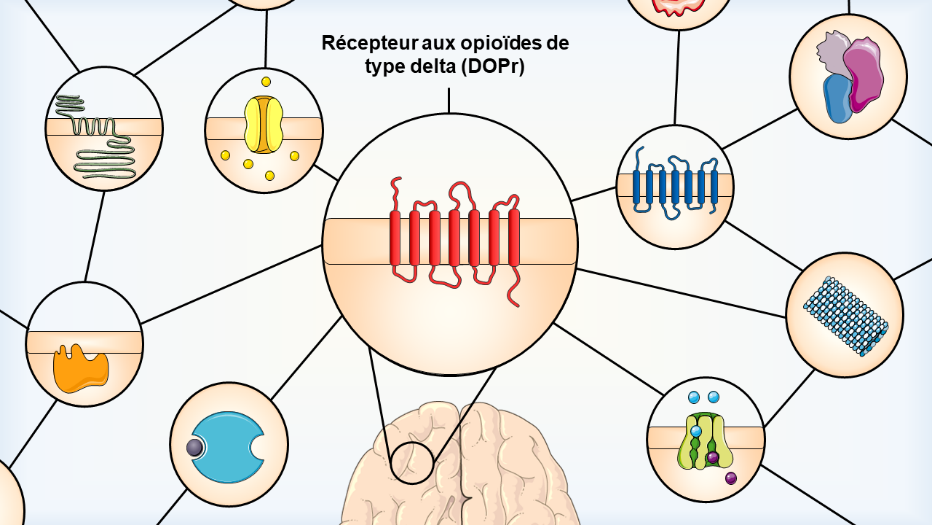
The unique network interacting proteins will dictate the localization and signaling of the DOPr, thus impacting its physiological functions such as analgesic effects (pain-relieving).
Take home message
The meaningful impact of this publication has been repeatedly highlighted. The production of this unique mouse model also paves the way to several perspectives which are discussed in this selected publication
